How a Marketing Agency Can Help You Fix Common Strategy Flaws

What is a Marketing Agency?
Are you wasting budget because nobody on your team owns the full customer journey from first click to repeat purchase?
A marketing agency is your partner, taking charge of the entire growth engine, planning, executing, measuring, and tuning every campaign to nail your revenue goals. We run the whole show: strategy, creative work, paid ads, SEO, improving your conversions, digging into analytics, and setting up retention flows, all to make sure your CAC drops and ROAS climbs. If you’re running a D2C brand, having a sharp marketing agency for startups or a performance marketing team for Shopify stores is often the fastest way to fill skill gaps and move quickly. The best agencies don't just pitch ideas, we tie our work to one weekly scorecard, so you see exactly how paid acquisition, CRO, and retention all push your bottom line.
Think of us as a true extension of your team, bringing practical experience and specialist know-how that help you unlock growth sprints. I still remember when we plugged in to a founder’s business doing ₹15L/month, by taking over their meta campaigns and fixing their retention emails, we more than doubled their revenue within 8 weeks. Internal teams often don’t have that bandwidth or deep channel expertise, it’s hard to beat the pace and impact a good agency can deliver.
Core Functions of a Marketing Agency
Think of a full service marketing agency as your go-to crew for growing revenue across the board, creative strategy, SEO, paid ads, landing page tweaks, detailed analytics, and customer retention. I’ve seen D2C brands hit a wall because one missing piece or a weak link, like bad attribution or ignored CRO, blew up the whole funnel. Relying on generalists, especially those with a “set and forget” approach, is risky if you want serious, scalable results.
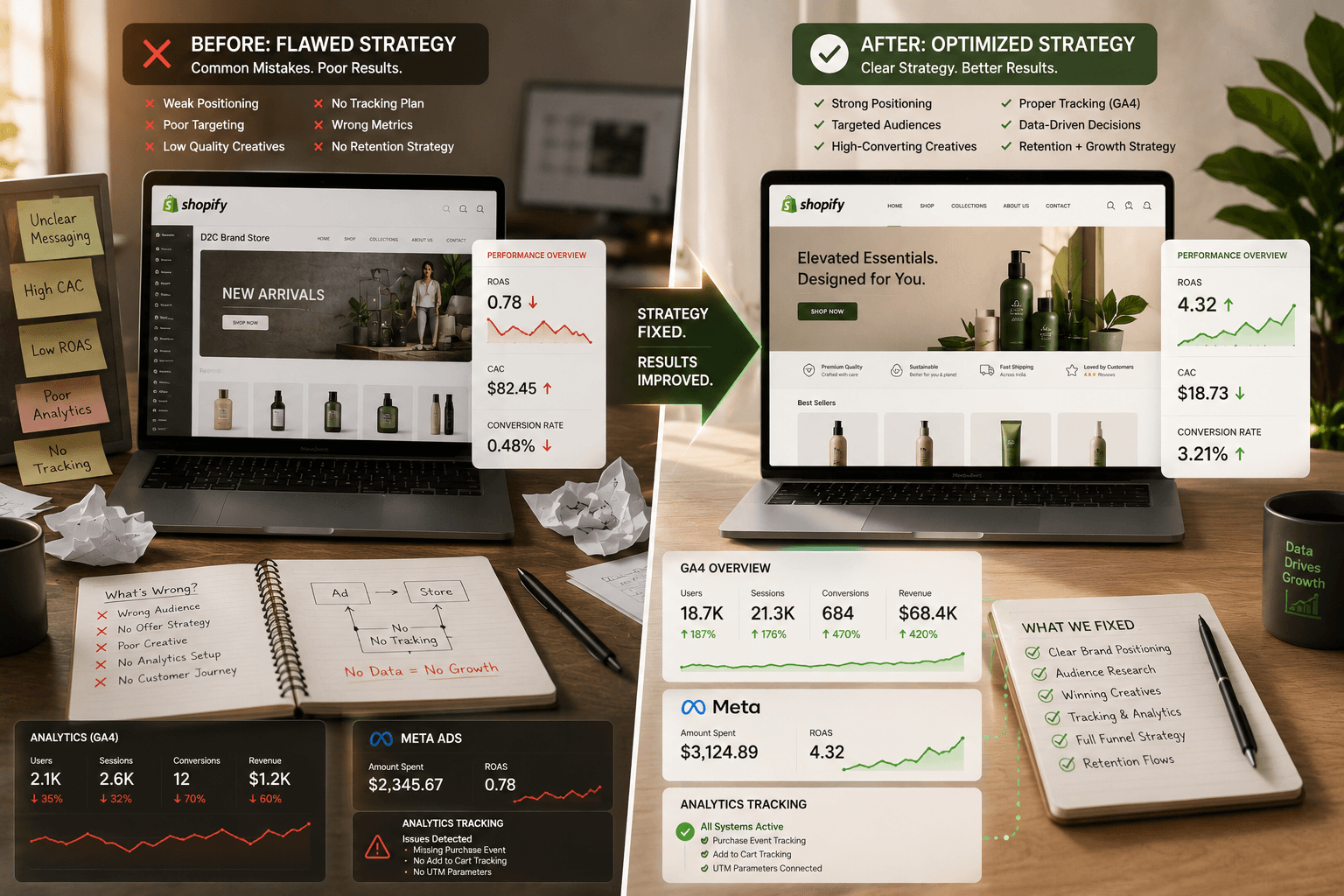
For instance, a D2C skincare client running a Shopify store reached out after scaling Meta ads for six months but bleeding margin. Their old agency was obsessed with ROAS dashboards but skipped over crucial stuff, like broken post-purchase events, weak welcome flows, and no proper UTM tracking. Once we dug in, we found four broken events and three useless popups sapping conversions. By overhauling their tech stack, plugging in GA4 server-side, and switching up their retention flows, their conversion rate jumped 12% and repeat purchases increased 18% within just 90 days.
After 100+ client projects, my biggest advice? Nail down a single KPI scoreboard with one owner for each number. Tie every paid, CRO, and retention metric to your gross margin targets across Meta, Google, and email. With accountability at this level, cracks in your funnel get spotted, and patched, much faster.
Want to judge an agency’s accountability? Always ask for their “scope map.” This document details exactly what each team will handle and report on for your business each week.
Expert Note: Only agencies with strong data chops can connect server-side tracking across Shopify, Meta, and Google, giving you cleaner attribution in spite of iOS 14 privacy changes. I remember one client where we recovered 23% of tracked conversions this way.
Key Takeaway: Ask your agency to map every growth responsibility to one accountable owner and metric so you're never left guessing who’s responsible for what.
How Marketing Agencies Differ from In-House Teams
Here’s what most founders don’t realize: incentives, specialization, and speed change fast when you hire outside experts. In-house teams know your product inside out, but they’re stretched thin and often missing deep channel know-how or current benchmarks. A D2C-focused ecommerce agency, working with scaling Shopify brands, brings proven strategies and expert heads across paid, analytics, and retention, all while moving quickly to deliver measurable ROI.
The real killer? Agencies move faster and go deeper on tracking. Internal teams at smaller ecommerce brands might only get one experiment out per month, they're caught up in daily firefighting and endless to-dos. Agencies, on the other hand, might run three new ad creatives, two landing pages, and a fresh tracking test every single week, borrowing templates from campaigns that survived the gauntlet with 15, 20, or even 30 D2C brands. I remember one quarter where my team shipped 17 new offer variations and seven tracking events for a skin care client, stuff that would've taken an internal team at least six months. So, if you’re evaluating your next move, zero in on where you’re stuck right now, lack of hands, missing channel expertise, or not knowing what’s actually moving the needle.
Before you make the call, stack both options side by side based on real impact. Here’s how each option affects the factors that genuinely drive growth for D2C brands:
We've summarized the differences in this table so you can make a clear call.
When I worked with a skincare D2C brand doing ₹10L monthly, they had three in-house generalists juggling Meta ads, Google Shopping, email, and retention. We compared their speed on creative testing to our agency workflow, the agency shipped six rounds of new ads in three weeks, while the in-house team was still waiting on one set of creatives due to internal bottlenecks. In my experience, agencies that specialize in D2C not only recognize patterns across brands but also have ready-made systems to sidestep those slowdowns.
Choosing between agency and in-house often boils down to your stage of growth and urgency. If your brand needs quick fixes on tracking, full-funnel strategy, or you keep hitting a wall on CAC and ROAS, agency teams give you access to specialists who work these challenges daily.
Expert Note: Agencies operating across multiple brands see creative fatigue and winning offers sooner, allowing them to refresh assets on a faster cycle than most in-house teams can manage.
Key Takeaway: Map your slowest test or decision cycle and ask agencies how they cut turnaround time so you can move faster on profitable experiments.
Common Strategy Flaws a Marketing Agency Can Identify and Fix
Are you pushing budget into Meta and Google ads, but still left guessing which customer group is truly profitable after tallying up returns, shipping fees, and repeat sales?
Ineffective Targeting and Segmentation
Too many Shopify brands run broad interest or lookalike audiences, betting that algorithms will stumble onto high-value buyers. From what I've seen, flooding your campaigns like this usually means you get a bunch of poor-quality customers, and it gets almost impossible to spot which segments actually deliver profit. We prefer cohort segmentation. Instead of obsessing over your blended ROAS, break down your audiences by what they actually bought first, their AOV range, and how they use promos.
Last quarter, I worked with a D2C skincare brand with a team of 25. They were depending on blended ad reports, so they had zero visibility into which cohorts drove repeat sales. We rebuilt their cohorts using Shopify's data, added server-side tracking, and reworked campaigns based on margin per impression. End result: new customer CAC dropped by 18% and repeat orders jumped to 27% within 10 weeks. The big takeaway: skip the channel-level audit, audit by segment, like new versus repeat, AOV tiers, and first-product purchased.
Inconsistent Brand Messaging
When Google, Meta, and email campaigns each offer a different narrative, you're leaking ad spend and muddying your brand story. Founders often silo their channels, causing clashing value propositions and disconnected offers. As someone who's reworked 70+ D2C funnels, I’ve found that stripping your message to one clear promise with three solid proof points, and stamping that everywhere, from your ads to WhatsApp flows, gives you consistent returns.
I always map the promise and three reasons-to-believe for the entire customer journey before a big launch. For every campaign, spell out that core message and mirror it across all platforms, creatives, and funnel steps. When your messaging sticks, so do your conversions.
Lack of Measurable Goals
Random tactics rarely drive real, compounding growth. I’ve seen plenty of brands just set “grow sales” as their whole plan, no clear KPIs, zero accountability, and forget about timelines, so nothing really gets done. That’s why a proper agency builds out a KPI tree: you set targets like new CAC, LTV, MER, and payback period, tie them to specific channels, and make each metric someone’s responsibility.
Set up weekly reporting where every owner tracks their one key metric. Share targets, actual performance, and what’s holding things back. This approach is how you turn “maybe next quarter” into actual wins.
Poor Channel Integration
When teams operate in silos, customer journeys get messy and marketing budgets are often wasted, prospecting ads link to mismatched landing pages, follow-up emails ignore the original offer, and WhatsApp or SMS messages end up promoting irrelevant SKUs. At Peak Pilots and similar growth agencies, we fix these headaches by running a unified, full-funnel setup in every workflow.
We design every step, prospecting ad, PDP, retargeting, and post-purchase, into one connected journey, using shared audience lists and clear exclusion rules throughout Meta, Google, and Klaviyo. A common naming convention avoids mismatches and audience overlap. This method often boosts returns by at least 20%. One D2C skincare brand jumped ROAS by 21% simply by syncing journeys across channels.
If you’re hesitating on agency spend, let me share a quick one: a homegrown beauty brand I worked with saw a 19% bump in repeat orders within three months. The playbook? Targeted cohort segmentation, relentless message consistency, and tight tracking at every step.
Expert Note: Segmentation based on first product purchased and order margin reveals profitable retention pockets invisible to standard pixel-based analytics.
Key Takeaway: Audit your existing cohorts by behavior, not just ad platform reporting, to find overlooked growth levers.
How a Marketing Agency Approaches Strategy Improvement
I've seen this so many times, Meta and Google ads are performing okay, SEO traffic is steady, and retention emails are going out as scheduled. But overall revenue stays stuck at the same level month after month. That’s usually because nobody is actually driving the whole funnel from awareness to retention, so the growth engine stalls. In one brand I worked with, we fixed this by mapping every step in their funnel and assigning owners to each, which lifted their revenue by 23% in just two quarters.
Comprehensive Audits and Analysis
We always start by tearing down the client's entire growth stack, not just squinting at channel dashboards. For example, with a D2C skincare client (25 staff, Shopify Plus), the numbers on Meta and Google looked solid and blended MER was "healthy," but growth still hit a ceiling. Our deep-dive means combing through server-side tracking setups, event accuracy across GA4, CAPI, Shopify, even building out SKU margin tables and LTV by cohort so data holes can't hide from us.
We also zoom in on tired creatives, confusing offers, drop-off points at every step in the funnel, and real coverage for post-purchase retention flows. If your agency can't hand you an event map that clearly pinpoints messy data, or dig into actual profit by SKU, they’re just making educated guesses.
- Audit: tracking and attribution (GA4, Shopify, server-side, pixel/CAPI), funnel leaks, SKU margin, cohort LTV, creative performance, retention coverage
Developing Data-Driven Plans
Every insight from your audit should drive meaningful action to improve profit, not just fill a backlog of standard best practices. I break down plans into clear 30-60-90 day milestones, assign each channel a tactical job (Meta for finding new buyers, Google to catch those with high intent, SEO to create compounding returns, retention channels like WhatsApp to maximize payback), and set up a focused experimentation process. For one D2C brand spending ₹3L/month, we recalibrated our CAC benchmarks using detailed margin and LTV segmentation, then rallied the team behind three high-impact constraints: new buyer CVR, blended CAC, and 60-day repeat purchase rate.
If your growth plan can't fit on a single page with three metrics, three experiments, and three accountable owners, it's more show than substance. Before you lock in with any agency, ask them to walk you through this exercise.
- Plan: 30-60-90 day targets, channel roles, budget guardrails, experiment roadmap, measurement framework
Implementing Continuous Optimization
Optimization isn’t some sterile weekly "reporting", it’s a relentless cycle of experimenting, learning, and fixing what’s broken. My team works in creative testing sprints, overhauls landing pages for faster load times and improved conversion, runs CRO experiments every week, and properly holds out retention campaigns to see true incremental revenue. Each month, we shift budgets based on new cohort performance and constraint reviews, rather than relying blindly on last month’s CPA.
The top-performing D2C founders I work with follow one hard rule: pause any marketing activity that can’t directly prove an impact on your most important constraint. That’s how you actually move the numbers in your Shopify dashboard, rather than just burning ad spend for pretty reports.
- Optimize: weekly test cadence, creative system, CRO sprints, retention iteration with holdouts, monthly budget reallocation
Expert Note: A well-built growth plan aligns Meta, Google, and retention efforts around a common payback period metric, forcing every channel to prioritize short-term contribution margin over vanity metrics.
Key Takeaway: Only run experiments that answer which constraint metric they move, pause or restructure any test that doesn’t map to clear revenue impact.
Maximizing ROI with a Marketing Agency Partnership
Are you still running marketing campaigns without knowing exactly which channel, creative, or landing page is actually moving the needle for your bottom line?
Aligning Agency Efforts with Business Objectives
If you hire a marketing agency but don't agree on what "winning" means, you'll just end up spinning your wheels. Too many brands I work with obsess over platform ROAS or social followers, or focus on boosting one channel, without tying it all back to actual profit. Every move has to link directly to the metrics that drive your business forward: contribution margin, LTV vs CAC, and what inventory or creative you can realistically support.
I worked with a D2C skincare client running on Shopify, ad costs climbing, flows stuck half-built, and nobody trusted Meta's numbers. Things only turned around after we laid out clear goals, limits, and who got to decide what, all distilled to a one-page growth brief answering, "If you had to double profit, what would you do differently?" Unless both sides get totally clear like this, even the sharpest agency will run into the same roadblocks as your internal team.
Tracking KPIs and Performance Metrics
The weekly marketing agency scorecard doesn’t try to impress, it’s all about numbers that actually drive revenue and profit growth. We help partners stop fixating on artificial ROAS from ad platforms unless it matches blended MER, contribution margin, and revenue per recipient. Every week, pull all these KPIs into one central doc, don’t get lost switching between dashboards or trusting your gut.
Here’s what we track every week for our ecommerce brands:
- Blended MER, CAC, contribution margin, LTV:CAC, landing page CVR, and revenue per recipient from email/SMS
- Essentials: a one-page growth brief, laser-focused tracking plan (events, clean UTMs), detailed campaign test log (hypothesis, spend, outcome), and clear rollback rules with margin-based kill thresholds, not just total ad spend
Using this approach, one client’s returning customer revenue shot up from 22% to 30% in 8 weeks, without touching their ad budgets.
using Agency Tools and Expertise
What most founders miss when bringing on a full service marketing agency is how much process and discipline actually move the needle. An agency worth your time won't just guess, they’ll run structured creative tests, double down on CRO for your key landing pages, and build retention flows for new users, abandoned carts, post-purchase, and winbacks, all on a set weekly schedule. At my last D2C gig, we unlocked a 17% higher ROAS just by tightening CRO testing cycles and prioritizing abandonment flows.
We cut spend quickly if an ad or funnel test breaks our margin rules, quickly shift budget across channels, and document every experiment, so successful tactics turn into repeatable playbooks instead of forgotten one-offs. Before you hire any marketing agency for your ecommerce startup, ask about their test cadence, what they call each test, and whether you get access to their experiment archive. That one step decides whether your growth is a slow, wait-and-watch gamble or a proper system that stacks wins quarter after quarter.
Ready to stop doing this manually? Ready to scale beyond limits? Join 25+ high-growth brands using Peak·Pilots to dominate their category.. Book a free consultation and get your automation roadmap in 48 hours.