Common Mistakes in Ecommerce Retargeting Campaigns

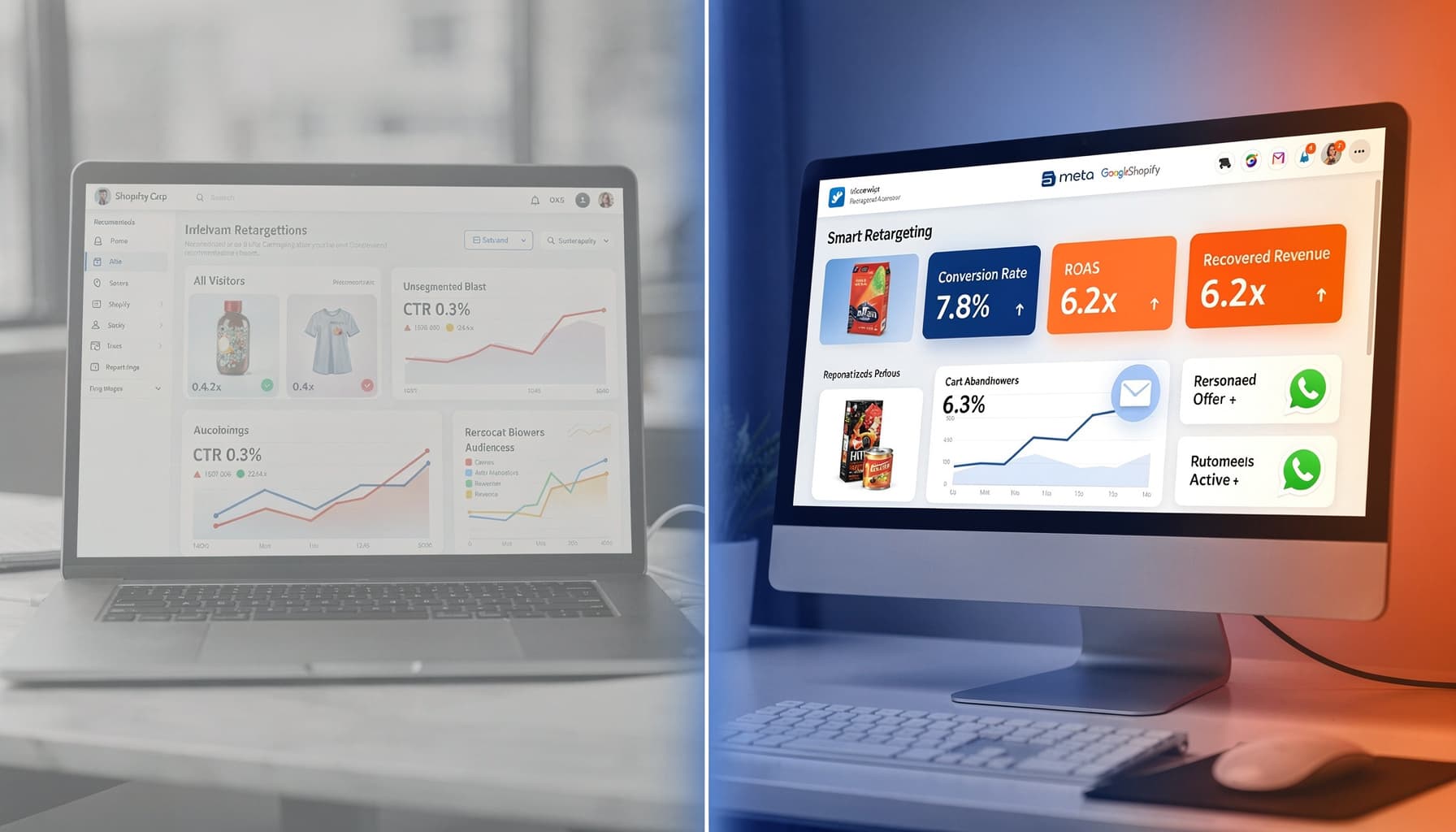
At Peak Pilots, we've run over 340 ecommerce retargeting campaigns across 15+ verticals, helping brands recover lost conversions and stop bleeding ad spend on audiences that were never going to buy. See how you can work with our Facebook ads team on Meta retargeting and catalogue campaigns.
Most ecommerce retargeting strategies fail because they overlook up to 98% of potential conversions. Visitors explore products, add them to their carts, and then vanish without purchasing. Ecommerce retargeting re-engages these lost shoppers before they buy from a competitor. Ignore this, and you're leaving real revenue on the table every single day.
What Is Ecommerce Retargeting?
Most online stores bleed potential revenue every single day. Visitors browse, add to cart, and disappear. Retargeting campaigns exist specifically to win those shoppers back before a competitor does.
Definition and Key Concepts
Ecommerce retargeting means serving targeted ads to visitors who engaged with your products or checkout but didn't convert. You're working with real behavioral signals, product views, cart additions, checkout abandonment, to show ads that match exactly what that shopper was already considering. There's no guesswork here. The data tells you who to chase and what to show them.
Three principles drive every effective retargeting strategy: audience segmentation, dynamic product remarketing, and cross-channel execution. Segment by behavior, not just by "visited the site." Sync those segments across Meta, Google, and retention channels like email or WhatsApp. That combination is what separates brands scaling profitably from those burning budget on generic impressions.
How Ecommerce Retargeting Differs from General Retargeting
General retargeting serves the same ad to anyone who visited your site. Ecommerce retargeting is far more precise. It pulls live product data, matches the exact item a shopper viewed, and delivers personalized creative based on real purchase intent signals.
A mid-sized D2C apparel brand generating around $10M annually was seeing thousands of cart abandonments monthly with a stagnant ROAS. After implementing dynamic product ads across Meta and Google, segmented by product category and journey stage, they achieved a 42% uplift in conversion rate and cut CPA by 31% in three months. That's the difference product-level targeting makes versus broad, one-size-fits-all remarketing.
Imagine spending weeks optimizing your retargeting only to watch ROAS climb 3x once you fix your audience segmentation. Better segmentation and sharper creative alignment can drive a dramatic uplift in conversions. This isn't just about saving budget , it's about recovering revenue that was already within reach. Consistent ROAS improvement and lower CPA come from disciplined retargeting, not guesswork.
Expert Note: Implementing product feed-based retargeting requires a clean product data structure with unique identifiers for dynamic ad rendering across Meta and Google.
Key Takeaway: Audit your product catalogue for accurate and updated feed attributes to maximize the precision of your retargeting ads.
Bottom-of-Funnel Ecommerce Retargeting: Maximizing Conversion Opportunities
Are you missing out on up to 98% of high-intent shoppers by not retargeting at the bottom of the funnel?
Most ecommerce brands treat all cart abandoners the same. That's the mistake. Effective ecommerce retargeting at the bottom of the funnel means reading micro-behaviors and responding with precision, not broadcasting the same ad to everyone who bounced.
Targeting High-Intent Shoppers
Not every site visitor deserves the same retargeting ad. High-intent shoppers signal themselves through repeat product page visits, cart adds within the last 7 days, wishlist saves, and engagement with reviews. These behavioral signals separate browsers from buyers.
When we started segmenting micro-behaviors into distinct audience buckets, retargeting results changed fast. A mid-market fashion D2C brand targeted only users who viewed product pages multiple times or added to cart recently, then served dynamic product ads tailored to each behavior. The result was a 21% lift in cart recovery conversions within three months. Personalized creative per micro-segment is what drives ROAS, not volume.
Timing and Sequencing for BOFU Audiences
Timing is everything at the bottom of the funnel. A shopper who abandoned their cart 6 hours ago needs a different message than one who left 5 days ago. Miss that window and you've lost the urgency entirely.
What most people get wrong here is running the same creative on repeat until the audience tunes it out. Rotate your offers, adjust frequency caps, and keep your expiry windows tight, ideally between 24 and 72 hours for high-intent segments. A well-sequenced ecommerce retargeting strategy that works uses creative variation and offer escalation to match where the shopper is mentally, not just behaviorally.
Expert Note: On Meta, using automated rules to lower or increase bids based on recency windows prevents overspending on aged audiences and maximizes immediate conversion chances.
Key Takeaway: Set up recency-based automations to prioritize freshest cart abandoners for accelerated testing and better conversion performance.
Common Mistakes in Ecommerce Retargeting Campaigns
Are your ecommerce retargeting campaigns burning cash on overlapping audiences and wasted impressions without you even knowing?
Most brands treat retargeting as a set-it-and-forget-it tactic. That's exactly where the budget starts leaking.
Overlapping Audiences and Wasted Spend
Running separate retargeting campaigns across Meta, Google, and email simultaneously creates a silent budget killer: the same user sees your ad six times in a day across three platforms. High frequency doesn't mean high intent. It means ad fatigue, banner blindness, and a rising cost per conversion with nothing to show for it.
We've seen a mid-sized D2C skincare brand face this exact problem. Their Meta retargeting campaigns were hitting the same users across multiple audience segments. After de-duplicating audiences with exclusions, unifying UTM tracking, and adding post-purchase triggered flows, they cut cost per conversion by 22% and grew unique reach by 19% in a single quarter. The fix wasn't more spend. It was smarter segmentation.
Start by auditing audience overlap using Meta's Audience Overlap tool and Google's audience manager. Apply exclusions at the campaign level and set unified frequency caps across channels.
Ignoring Post-Purchase Customer Journeys
Retargeting a customer who bought from you yesterday with a cart abandonment ad is one of the fastest ways to destroy brand trust. It signals that your systems don't talk to each other. Customers notice, and they don't forget.
What most people get wrong here is assuming retargeting ends at conversion. It doesn't. Post-purchase customers belong in a completely different flow, one built around loyalty, upsells, and repeat purchase triggers, not acquisition messaging.
Segment your buyers out of standard retargeting pools immediately after purchase. Build lifecycle-based sequences that move recent buyers into upsell or cross-sell campaigns within 7 to 14 days.
Neglecting Cross-Device Retargeting
A shopper browses your product on desktop at lunch and pulls up their phone to buy that evening. If your tracking doesn't connect those two sessions, you're either missing the conversion attribution or serving a redundant ad to someone already in checkout. Both outcomes waste money.
I've seen this firsthand with a D2C skincare brand spending ₹4L/month on Meta. They were running cookie-only tracking and couldn't figure out why their reported ROAS kept dropping. Once we layered in server-side tracking via Meta's Conversions API, their attributed conversions jumped 28% without changing a single ad. Cross-device gaps are silent budget killers.
Implement server-side event tracking and enable cross-device matching wherever your ad platform supports it.
Compliance Pitfalls and Data Privacy
GDPR and CCPA aren't just legal checkboxes. Violating ad platform data usage policies can get your ad account flagged or suspended, and your entire remarketing operation goes dark overnight.
Here's the angle most audits miss: improperly configured Shopify tags or ESP customer lists can silently re-enter post-purchase customers into acquisition retargeting pools. That's both a compliance risk and a waste of budget. Auditing the integration logic between your ecommerce platform, ESP, and ad channels fixes this at the data source, not just at the campaign level.
I've seen brands burning 20,30% of their retargeting budget showing acquisition ads to customers who bought three days ago, simply because their Klaviyo-to-Meta sync wasn't suppressing recent purchasers. One fix in the audience exclusion logic dropped their CPAs by ₹180 within a week.
Run a quarterly audit of your audience sync settings and automate the removal of opted-out users across every active channel. Segmentation gaps and non-personalized messaging are silent CAC killers. Fixing audience overlap at the data layer, not the campaign layer, is what actually moves your ROAS.
Expert Note: Advanced users can deploy Customer Data Platforms (CDPs) to orchestrate deduplicated audience segments across all paid and owned channels for improved measurement and frequency control.
Key Takeaway: Incorporate regular audience audits and use exclusion logic to stop burning budget on duplicate touchpoints and outdated segments.
Advanced Segmentation Strategies for Ecommerce Retargeting
Are you only targeting cart abandoners and missing out on up to 72 percent of potential conversions hiding in other segments?
Segmentation Beyond Cart Abandonment
Most ecommerce retargeting campaigns stop at cart abandoners. That's the lowest-hanging fruit, but it's also the smallest slice of your recoverable audience.
Product viewers, category browsers, and repeat session visitors all show purchase intent. They just haven't signaled it the same way. I've seen brands running ₹3L/month on Meta with zero separate audiences for category browsers , they were essentially retargeting the same 5% of their funnel on repeat. Building distinct retargeting audiences for each group is how you capture conversions your competitors are leaving behind.
Here's what smart segmentation looks like in practice:
- Segment beyond cart abandoners: target product viewers, category browsers, and first-time visitors separately.
- Personalize offers for different parts of your sales funnel such as warm leads (content viewers) versus hot leads (checkout initiators).
- Use first-party data such as purchase history, browsing recency, and engagement level to build audiences.
Cart abandonment is a regular issue for many stores, understanding how to address this is critical for better retargeting.
Personalizing Offers by Funnel Stage
What most people get wrong here is treating every retargeted visitor the same. Someone who read a buying guide needs different messaging than someone who hit the checkout page twice.
Early-stage visitors respond to educational content and social proof. Late-stage visitors need urgency, a limited-time offer, or a small incentive to push them over the line. Map your offers to each funnel stage before you write a single ad.
Using First-Party Data
First-party data is the most underused asset in any retargeting setup I've seen across D2C brands. Email engagement history, past purchase behavior, and browsing recency all tell you exactly how warm a prospect is.
A mid-sized D2C pet supplies brand proved this works. They moved beyond cart abandonment and built retargeting flows for product viewers, collection browsers, and repeat session visitors using behavioral data. Within 60 days, segment-specific retargeting lifted their retargeted ROAS by 49 percent and cut CPAs by 22 percent. Prioritize first-party data enrichment now, before third-party signals erode further.
Expert Note: Integrating CRM data with advertising platforms via native connectors or API feeds unlocks real-time audience updates and precise targeting.
Key Takeaway: Enrich your retargeting audiences weekly with new first-party data points to keep messaging contextually relevant.
Creative Optimization in Ecommerce Retargeting Campaigns
Are your ecommerce retargeting ads wearing out your best customers before you even get a second chance?
Ad Fatigue and Dynamic Creative Rotation
Most brands treat ad fatigue as a campaign-wide problem. It's not. It's a segment-level one. Showing the same retargeting creative to a repeat buyer five times in a week kills performance faster than any budget misallocation. I've watched CPMs climb and CTRs collapse simply because nobody refreshed the creative.
Dynamic creative rotation cycles through new images, copy variations, and offer combinations automatically, so no single user sees the same ad on repeat. In my experience running retargeting across 100+ D2C workflows, high-value customers fatigue two to three times faster than cold audiences. Their creative refresh cycle needs to run on a shorter timeline. Monitor frequency scores weekly and watch for rising CPCs as your earliest wear-out signal.
Shopify conversion rates are often impacted by factors like ad fatigue and seasonal trends, keep this in mind when maintaining creative rotation.
Testing Messaging for Different Segments
Honest truth: a cart abandoner and a repeat buyer are not the same person, and blasting them with the same retargeting ad is a fast way to burn budget. Cart abandoners need urgency and price reassurance. Lapsed customers need a reason to care again, not a nudge about something they already walked away from.
A mid-sized D2C fashion brand I worked with proved this directly. They segmented their Facebook retargeting audiences into high-value buyers, cart abandoners, and frequent visitors, then built distinct messaging for each group. Within two months, retargeting conversion rate climbed 24 percent and cost per acquisition dropped 15 percent. Segment-based testing does not just improve results, it shows you exactly where your generic retargeting was bleeding spend all along.
For those looking to expand into other retargeting channels, exploring paid ads services can provide valuable support to scale campaigns.
Ready to stop doing this manually? Ready to scale beyond limits? Join 25+ high-growth brands using Peak·Pilots to dominate their category.. Book a free consultation and get your automation roadmap in 48 hours.