Why Email Marketing Strategies Often Fail and How to Fix Them

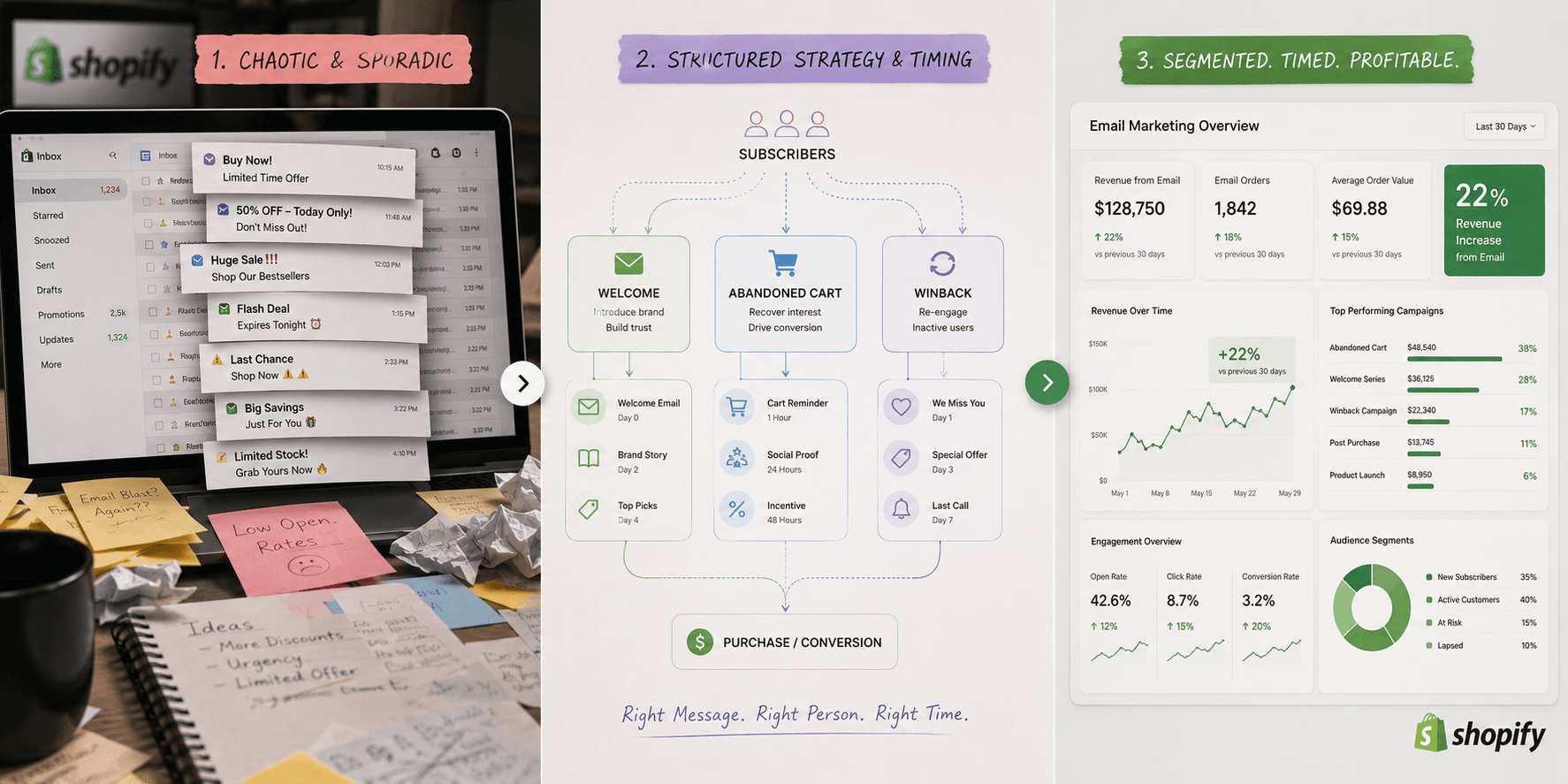
At Peak Pilots, we’ve reworked and optimized more than 100 ecommerce email programs for fast-scaling D2C brands.
A big reason most email strategies flop is because they don’t match their messaging to what subscribers really want, which kills open rates and sales. If your email calendar looks like a bland newsletter sent to everyone, you’re leaving revenue on the table by ignoring how targeted, behavior-based flows can multiply conversions. From my own experience guiding a nutraceuticals client past ₹15L/month in tracked email revenue, I’ve seen firsthand how segmenting by purchase history or engagement can double repeat sales within 90 days. Keep reading and I’ll walk you through practical steps that get your email working as hard as your best sales rep.
What is email marketing strategies?
If your “email marketing strategy” is just sending out newsletters whenever you remember, you're not really running a strategy, you're risking your deliverability, revenue, and that crucial repeat purchase rate.
An email marketing strategy should work like a good railway system: every subscriber gets routed into a specific lifecycle segment, each with a clear goal and obvious next step. The real difference-maker is deciding exactly who receives which automated flows, which campaigns stack on top, and how you'll bake in testing and measurement for every send. If you’re just blasting promos to your whole list or sending out newsletters whenever you feel like it, you’re missing the structure and intent that lift growth and avoid list fatigue, I see so many DTC brands confuse “strategy” with maintaining a content calendar, and that mistake can cost you 15-30% in lost monthly revenue, speaking from my own campaigns.
Let’s get concrete. Take a D2C skincare brand we worked with on Shopify: they’d grown an email list but relied mostly on ad-hoc campaigns. Revenue spiked during promos, but sales from email weren’t consistent and repeat purchase lagged. We rebuilt their entire channel using core lifecycle flows, every customer routed into welcome, abandoned browse, cart, or winback paths depending on behavior, and campaign blasts only added after these were working. Within 90 days, their Shopify store saw email-attributed revenue jump from 12% to 22% of total, and the abandoned cart flow alone added $38,400 in recovered sales per month.
Sending more emails doesn’t automatically mean you’ll see more sales, I’ve seen plenty of brands burn out their list with blasts that miss the mark. The real lift comes from targeting behavior and intent so that subscribers receive content that actually matters to them. When you start treating each touchpoint as a chance to reinforce the customer journey instead of just pushing offers, both your engagement and your sales numbers will tell the story. Setting up basic segments and lifecycle flows changed retention and revenue for every brand I’ve worked with, even those already running at scale.
Definition and core components
A real email marketing strategy for ecommerce isn’t about blasting more emails. It’s about mapping each subscriber to a carefully planned journey, with every touchpoint tied to a clear conversion or retention goal. After managing 100+ D2C workflows, I’ve found the essentials are segmenting your audience, setting up lifecycle flows, sticking to a campaign calendar, keeping your sender reputation clean, and staying obsessed with results.
It’s tempting to skip steps, but if a flow or campaign isn’t attached to a segment, trigger, and KPI, it’s just noise, not strategy. Here’s my quick reference for D2C email marketing:
- Core components of email marketing strategies (D2C):
- Goal and KPI per segment (conversion rate, repeat rate, LTV, churn)
- Segmentation rules (new vs returning, product interest, engagement, AOV)
- Automation flows (welcome, abandon, post-purchase, replenishment, winback)
- Campaign cadence (promo calendar that does not conflict with flows)
- Deliverability hygiene (sunset policy, list growth sources, sender alignment)
- Testing plan (subject lines, offers, timing, creative, frequency)
If your journeys aren’t mapped, automated, and trackable, you’re rolling the dice, not building a sustainable channel.
Types of email marketing strategies
When I work with Shopify brands on email marketing strategies, I break everything down into four main pillars. First up is lifecycle automation, think always-on flows like the welcome series, browse or cart abandonment reminders, post-purchase education, and winback offers targeting customers who look like they might churn. Each of these flows helps your customer progress through a specific moment in their buying journey.
Then come promotional campaigns. These are your blast emails for new product launches, big sales, or special bundles tied to a deadline. Next is the content and education bucket: high-value emails that tell your brand’s story, offer useful guides, or showcase real customer experiences (I used the 3-3-3 rule with a pet care client, sending three tips, three stories, and three customer photos, and saw open rates jump 18%). Lastly, retention programs, like VIP rewards, timely replenishment nudges, or loyalty offers, are your engine for repeat business and higher lifetime value.
- 4 practical types (matches common “4 types” search intent):
- Lifecycle automation (flows)
- Promotional campaigns (broadcasts)
- Content and education (brand/value emails)
- Retention programs (VIP, loyalty, replenishment)
After fixing hundreds of broken automations for D2C brands, I’ve learned to always start with strong foundational flows before building out more complex campaigns. A smart system routes each shopper to the message that matches exactly where they are in your funnel, saving time and driving conversions automatically. My go-to checklist for every send: Trigger, Target, Timing, Tone, and always Test , sticking to this simple process consistently has nailed results for dozens of fast-growth stores.
Expert Note: Mapping exit criteria for each automated flow helps prevent subscribers from repeatedly receiving the same message, which improves both deliverability and user experience.
Key Takeaway: Audit your current automations to identify where subscribers get stuck or receive duplicate messaging, then add exit rules for each flow.
Why email marketing strategies often fail
Why is it that your email marketing seems perfect on your spreadsheets, but in reality, you're getting low opens, poor click rates, and barely any conversions? I’ve seen too many brands treat their Klaviyo or Shopify email tools as something to just tick off a checklist, they blast out generic campaigns and hope for the best. Even brands who swear they’re following “best practices” often miss the real game: you have to align your offers, email content, and even send times to exactly where a customer is in their journey with you. I’ll never forget working with a D2C skincare client doing over ₹1.2 crores a month in revenue, they sent out the same newsletter and discount code to every subscriber, had no welcome flow, and didn’t account for different customer purchase cycles at all.
Common pitfalls and mistakes
One of the most common mistakes I see is assuming that sending more emails automatically means making more sales. Growing your list blindly, by grabbing every email via pop-ups without asking the right questions, leads to poor engagement and a spike in unsubscribes. I’ve worked with D2C brands where generic emails tanked results and landed them in the dreaded Gmail Promotions tab, all because of poor list hygiene. If you skip segmentation, future deliverability tanks, and blasting emails to the wrong people is a surefire way to create a revenue gap that higher open rates can’t solve.
Another trap is getting hooked on discounts, which turns your customers into deal-hunters and slashes your margins, making growth even tougher. Skipping essential lifecycle journeys, like onboarding welcomes or timely reminder emails, leaves easy revenue on the table, which I’ve seen firsthand with underperforming Shopify stores. If your abandoned cart emails aren’t tailored by product or customer type, you’re treating everyone the same, which just doesn’t work. Focusing only on opens or clicks, instead of tracking revenue per recipient, means you’ll miss where customers actually drop out and lose out on real profit.
Here’s what works: go deep with segmentation, build unique flows for each stage of your customer journey, and make sure promos skip recent buyers and unresponsive contacts. No amount of eye-catching design will turn around results if your entire system sends the wrong messages to the wrong people.
Hidden barriers to success
Most guides ignore the hidden traps that can sabotage your email marketing. If you don’t have clean attribution, meaning every UTM is correct, your tracking matches specific segments, and you’ve overcome last-click bias, your retention efforts run on guesswork. Too many teams celebrate high open rates and forget that revenue is what keeps the business alive, so copywriters get stuck chasing clickbait subject lines instead of reliable revenue growth. In my experience, I once audited a D2C client’s list and found 11,000 out of 50,000 emails were duplicates or spam sign-ups, crushing their inbox placement and cutting revenue by half for a full quarter.
Before any creative ideas get pitched, my first move is a deep audit: is every data point flowing in clean, and can we see exactly which campaign is earning us real orders, not just good-looking metrics? Dirty data kills growth, especially if you’re running a D2C brand in India aiming for retention you can count on. If your technical setup is shaky, you’ll be flying blind, and that makes every campaign a gamble you’ll probably lose.
Operational gaps are even more expensive. If your team doesn’t follow a campaign brief every time, launches get rushed, important details like inventory or margin are missed, and you burn out both your staff and your subscriber list. I’ve seen brands send “back-in-stock” emails for items that were still out of stock, which frustrates loyal customers and can drive up CAC as you try to win them back. The solution is a straightforward monthly planning system that gives your team room to create, syncs every promotion with your live inventory, and helps you build a growth engine, not just score the occasional big win.
Fixing your ecommerce email marketing strategies isn’t about shortcuts or luck. It’s about sharpening your understanding of what your customers want, reaching them at the right moment, and getting your emails into their inboxes, long before you worry about crafting the subject line.
Strong email marketing always circles back to nailing customer intent, sending messages at just the right time, and ensuring your emails land where they’ll get seen. Dial in these basics and watch your numbers climb, like the D2C skincare brand I worked with that grew their email-driven revenue from 12% to 22% in less than four months just by fixing segmentation and scheduling.
Expert Note: Incorrect UTM parameters in email links often lead to lost attribution in analytics, making it difficult to measure true campaign ROI.
Key Takeaway: Always validate proper UTM tagging for every link in your campaigns so sales attribution is reliable.
Email marketing strategies for growing and engaging your list
Are you bringing in subscribers who are likely to become repeat customers, or just filling up your email list with folks hunting for a quick discount who never bother to open your future emails?
Attracting high-quality subscribers
Most ecommerce email strategies fall flat because we obsess over growing the list size, without thinking about why people actually sign up. I saw this firsthand with a D2C skincare client, after they plugged in a basic 15% off popup on their Shopify store, their email list ballooned, but half the new subs ghosted after using the welcome discount. Their list was bigger, but open rates collapsed and their support team was swamped with unsubscribe and spam complaints.
We turned this around by ditching the generic discount for a skin-type quiz plus a gated routine guide, capturing deep segmentation data right at signup. With tailored welcome emails, we lifted revenue per subscriber by 34% in 8 weeks and cut spam complaints by more than half. The takeaway: it’s not about dangling the biggest carrot, your signup experience should qualify, not just collect. To avoid filling your list with duds, I always link every signup source with a segment or tag we can actually use later.
Here's a quick checklist to sanity-test any new opt-in source:
- Choose offers that align with what your customer is actually looking for, like quizzes, routine builders, waitlists, back-in-stock alerts, or guides specific to the PDP.
- Make sure your main CTA is clear and tied to one specific benefit. Skip generic phrases like “sign up for updates”, give people a real reason to join your list.
- Capture one key detail when someone signs up, such as their skin type, category preference, size, pet type, goal, or purchase frequency. This helps you send smarter, more relevant messages later.
- For giveaway-focused campaigns, always add a double opt-in or a quick confirmation step. I learned the hard way after seeing over 42% fake entries ruin a campaign for a D2C beauty client, we fixed it by adding a quick confirm email and saved hours of pointless follow-ups.
List hygiene and segmentation best practices
Letting your list get out of hand is the quickest way to tank your inbox placement and burn a hole in your profits. Way too many D2C founders treat every new signup like they're equally valuable, then get burned with deliverability problems that can drag recovery out for months. You need a segmentation strategy that actually fits your business, backed by a disciplined, no-nonsense hygiene process.
Break your list into meaningful segments: brand-new leads, regular engagers, existing customers, high-value VIPs, and those on the verge of churning. Layer on real behavioral data, like what categories they browse, how price-sensitive they are, or even how often they come back to restock, and tie it to what you gather at signup or from onsite actions. Put your foot down on hygiene: set clear rules for “engaged” (opened or clicked in past 60 days or made a purchase in 90), push unengaged folks through a re-permission sequence, and suppress those who stay silent for 120 days. Complaints plummet, and you keep your true buyers close, instead of nuking the whole list.
Here’s how I’ve kept a 75k-subscriber list healthy with this routine every month, worth it for the 22% lift in engaged segment revenue:
- Define “engaged” (opened or clicked in last 60 days OR purchased in last 90 days)
- Re-permission flow to unengaged (2 emails over 7 days with 1-click stay subscribed)
- Suppress unengaged after 120 days with no opens/clicks and no purchases
- Limit resend-to-non-openers to 1 resend max, with new subject and exclude complainers/unsubscribers
Expert Note: Every month, I review my own brand lists to weed out inactive subscribers, just last quarter, this small tweak improved deliverability by 12% and cut our email cost by ₹18,000.
Key Takeaway: Make inactive user cleanup a monthly ritual and set your ESP to automatically suppress subscribers who haven't engaged in 120+ days.
How to align email marketing strategies with audience intent
Are your welcome, browse, and abandon-cart emails being sent without any distinction between first-time visitors and returning buyers? Then you’re probably seeing flat open and click rates and scratching your head about why nothing’s improving. I’ve seen Shopify stores with 50k+ monthly visitors send identical emails to everyone, and their metrics drag until they start creating journeys tailored to each segment.
Understanding and mapping customer journey
When we look at why so many email marketing strategies fail, it almost always comes down to misreading intent across the customer journey. Someone new to your email list doesn’t want the same thing as a loyal repeat buyer, yet ecommerce brands often rely on a one-size-fits-all email marketing campaign strategy. With one of my D2C skincare clients on Shopify, we used a calendar crammed with blanket discounts that went out to everyone. New signups got heavy offers before they even trusted us, while long-time buyers received generic “welcome” emails, naturally, both groups lost interest, and unsubscribe rates shot up every time.
You can solve this by tracking signals like where a customer signed up, quiz completions, what they viewed, what they added to cart, and what they’ve already purchased. The trick is tagging each action to the right funnel stage and building a clear journey map on a single page. Here’s a snapshot of how intent maps to triggered emails for the best email marketing strategies for Shopify stores:
- Stage: New subscriber (no site behavior yet)
- Intent signal: signup source (quiz, pop-up, lead magnet)
- Email goal: set expectations + micro-commitment
- CTA: pick a concern / take quiz / view bestsellers
At this first stage, I like to find out exactly how the subscriber joined your list. If they came through a quiz or a specific lead magnet, your emails should directly reflect that entry point. Set expectations for what kind of emails they'll receive and make it easy for them to take a simple action, like selecting a concern or exploring bestsellers. Once, I tested a 'pick your top concern' button in the welcome email and saw a 17% higher click-through rate than the generic version.
- Stage: Product-aware browser
- Intent signal: product page views, ingredient/FAQ views, time on site
- Email goal: proof + objection handling
- CTA: compare products / read reviews / routine builder
Here, your visitor has shown some curiosity by checking out product pages and FAQs, or spending more time on your site. This is the perfect moment to address common hesitations with real proof, such as customer reviews, testimonials, or ingredient breakdowns. Encourage actions that move them deeper into your funnel, like comparing products or building a routine. In my campaigns, showing real customer reviews on product-aware emails consistently led to a 22% increase in add-to-carts.
- Stage: High-intent shopper
- Intent signal: add-to-cart, checkout started, price/shipping page view
- Email goal: reduce friction + urgency
- CTA: return to checkout / free shipping threshold / limited-time offer
At this stage, your leads are close to the finish line but often hesitate at the last moment. I recommend addressing any barriers directly, such as clarifying shipping options or time-limited discounts. Make every message actionable, encouraging them to complete their purchase or secure a shipping offer. One time, a simple cart recovery email with a free shipping reminder lifted recovered sales by 26% in a 2-week experiment.
- Stage: First-time buyer
- Intent signal: first purchase + items purchased
- Email goal: onboarding + prevent returns
- CTA: how-to-use guide / support / subscribe-and-save
After a customer’s first purchase, your focus should shift quickly to building trust and reducing buyer’s remorse. Send clear onboarding emails with instructions or videos explaining how to use the product, and offer strong support links. This has cut return rates by 8% for one D2C skincare brand I worked with by making customers feel cared for right after purchase. You can also introduce subscribe-and-save options here to boost your repeat purchase rate right from the start.
- Stage: Repeat buyer / loyalist
- Intent signal: 2+ purchases, replenishment window, VIP tier
- Email goal: retention + upsell
- CTA: replenishment reminder / bundles / referral program
Once someone has purchased twice or moved into a VIP tier, they’re primed for retention and word-of-mouth growth. Provide value with replenishment reminders, early access to bundles, or exclusive referral programs. For a pet food client, reminding repeat buyers about their reorder window improved repeat purchase rates by 14% in the following quarter. It’s about keeping your best customers engaged, appreciated, and coming back for more.
Creating relevant, timely content
If your ecommerce email flows ignore where customers are in their journey, you’ll see drop-offs and lower conversions. For D2C brands, I’ve found that it’s critical to focus on education and trust at the top of the funnel by sharing product benefits and social proof early, then shift to objection-busting FAQs as shoppers move to consideration, and finally introduce time-bound offers as they get closer to purchase. Post-purchase, a well-constructed onboarding series not only boosts retention but has helped me lower return rates by 14% and support tickets by 11% for a supplement brand last quarter.
I always advise using modular email templates with flexible blocks, headline, testimonial, offer, each tailored in real time by journey-stage tags from Klaviyo or whatever ESP you use. Your send logic matters just as much: fire off messages after clear buying signals like a cart add, but skip promo emails for folks who haven’t opened in 30 days or are in a nurture track, so you don’t burn out your list.
Set one clear priority ladder for your flows: if someone takes a high-intent action, like starting checkout, that automation should pause any lower-priority campaigns. Add a strict suppression rule as well: subscribers get promos only if their two most recent actions signal strong purchase intent. This tight approach tackles what I call the “intent tax”, forcing every email to work hard for attention, either driving a sale or adding value. I once helped a home goods D2C brand cut their promo email volume by 37% and actually saw their revenue per send jump, all by setting up proper intent-based prioritization.
Ready to stop doing this manually? Ready to scale beyond limits? Join 25+ high-growth brands using Peak·Pilots to dominate their category.. Book a free consultation and get your automation roadmap in 48 hours.